Standing-water diagnosis
Help for Standing Water in Augusta Yards
University of Georgia guidance treats water remaining in a test hole after 12 hours as evidence of poorly drained soil. That observation can reveal a restrictive layer, while the timing and location of the original puddle still decide which cause deserves attention.
Editorial review: July 19, 2026. Cost figures and local guidance were rechecked on that date.
Augusta Yard Drainage Help is an independent educational and lead-generation website. It does not perform drainage work directly. Requests may be shared with a local outdoor drainage provider when a fit is available.
Quick answer
Build a timeline before naming a method: note when water appears, where it first enters the scene, when the visible pool vanishes, and when the soil becomes firm. Fast arrival usually supports runoff or a low-point explanation; delayed softness or refilling supports a subsurface question. These clues narrow the field without proving a design.
Read the clock before reading the soil
Water that appears while a downspout is flowing differs from a lawn that remains soft the next day. Record four moments from safe ground: first appearance, widest spread, disappearance of surface water, and return of firm footing. Repeat the record after another storm because one unusually intense rain can overwhelm an otherwise adequate route.
Use location to test the likely source
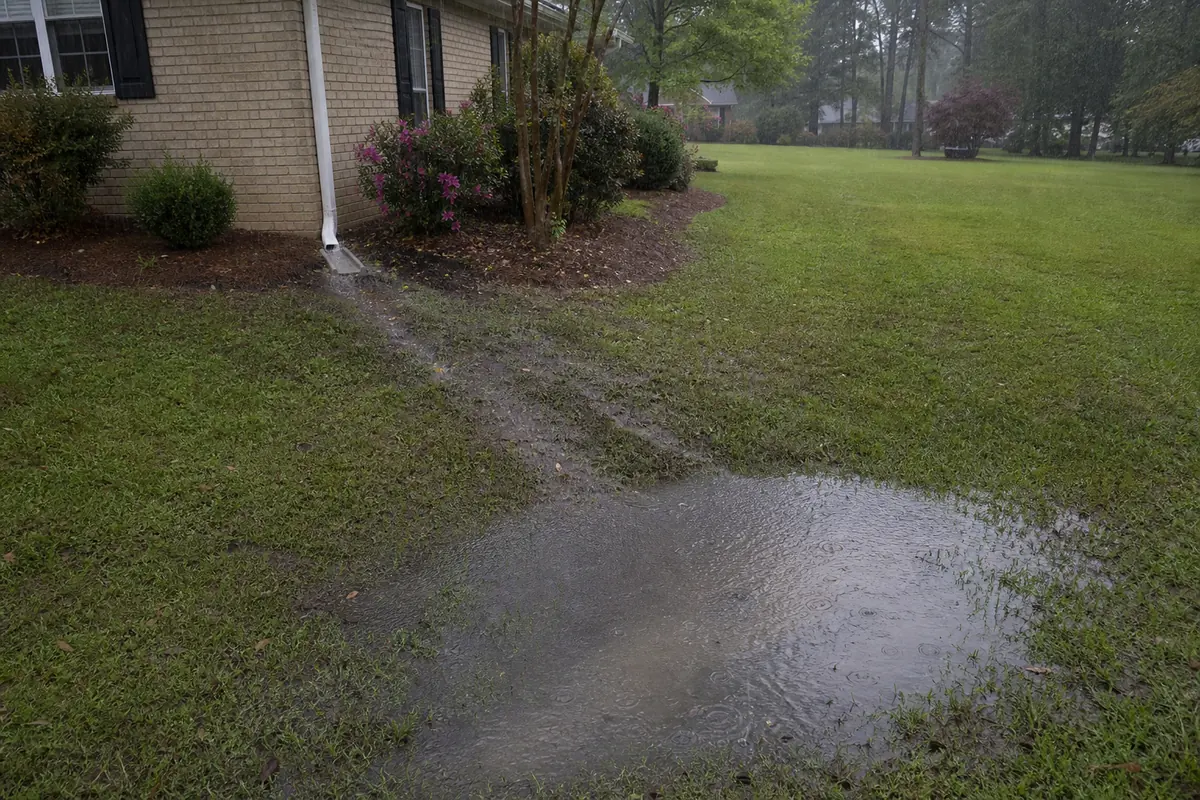
A pool directly below a gutter outlet usually starts with roof water. A shallow mid-lawn bowl suggests a surface collection point. A wide wet front at a patio or drive points toward surface grade. Water entering along a property edge should be documented by direction and timing without assigning responsibility or pushing it across the boundary.
Interpret the same softness differently across the fall line
On the clay-rich side of Augusta’s transition, persistent softness fits the familiar pattern of slow infiltration and water held in fine soil. On a sandy-side lot, the same symptom should trigger a search for compaction, hardpan, grading pockets, or a clay lens beneath the sand. USGS reporting near Augusta documents permeable sands interrupted by lower-permeability clay beds and lenses.
Sources: New Georgia Encyclopedia Augusta fall-line location · USGS Augusta-area sand and clay layers
Treat the 12-hour hole as one observation
UGA’s landscape guide says that water still present after 12 hours indicates poor drainage and may point to hardpan. A hole that drains sooner can still sit in the wrong place, miss a restrictive layer, or behave differently in another season. The result does not prove groundwater elevation, system capacity, or the need for a French drain.
Sources: UGA Water-Wise test-hole guidance
Account for utilities before a hand-dug test
Georgia law focuses the notice requirement on mechanized excavation, and Georgia 811 encourages homeowners who plan to dig by hand to contact the service as well. Check member responses before disturbing soil, then separately identify irrigation, septic, lighting, and other privately owned lines that standard public marking does not cover.
Sources: Georgia 811 ticket and hand-dig guidance · Georgia 811 private-facility limits
Route each behavior to one lane
A roof-fed pattern belongs with downspout inspection. Wide surface sheeting belongs with measured grading. A single low pool belongs with a basin discussion. A repeatable saturated band belongs with French-drain evaluation. This page stops at diagnosis so each method page can handle construction without repeating the test.
Stop the diagnosis when the scene becomes unsafe
Keep people and pets away from moving water, possible sewage, electrical equipment, and softened ground beside undermined hardscape. Observe from a stable location and use emergency or utility contacts when the hazard cannot wait for a yard-drainage review.
Common questions
What does standing water during rain usually indicate?
It commonly points toward active roof discharge, sheet flow, or a low point filling faster than its outlet can drain. Trace the first visible source.
What does softness after the puddle disappears mean?
Lingering softness supports a slow-infiltration or subsurface-water question. Clay can hold water, while sandy-side ground may hide compaction, hardpan, or a clay lens.
Does a 12-hour test hole diagnose the whole yard?
No. UGA uses retained water after 12 hours as a poor-drainage clue. The observation remains local to that hole and does not replace elevation, soil-profile, or seasonal review.
Should I make a test hole without contacting Georgia 811?
Georgia 811 encourages contact even for hand digging. Review utility responses and account separately for private irrigation, septic, lighting, and similar lines before disturbing soil.
Should I redirect water arriving near a property line?
Document where it enters and how it moves, then confirm the property and drainage context. Avoid concentrating the flow onto another parcel or public area.
Send your drainage details
Describe where the water begins, how it moves, where it collects, and how long it remains after rain.
Your request may be shared with a local outdoor drainage provider for follow-up. Submission does not guarantee availability, price, timing, or results.